The current Google picture is more complicated than I wrote before
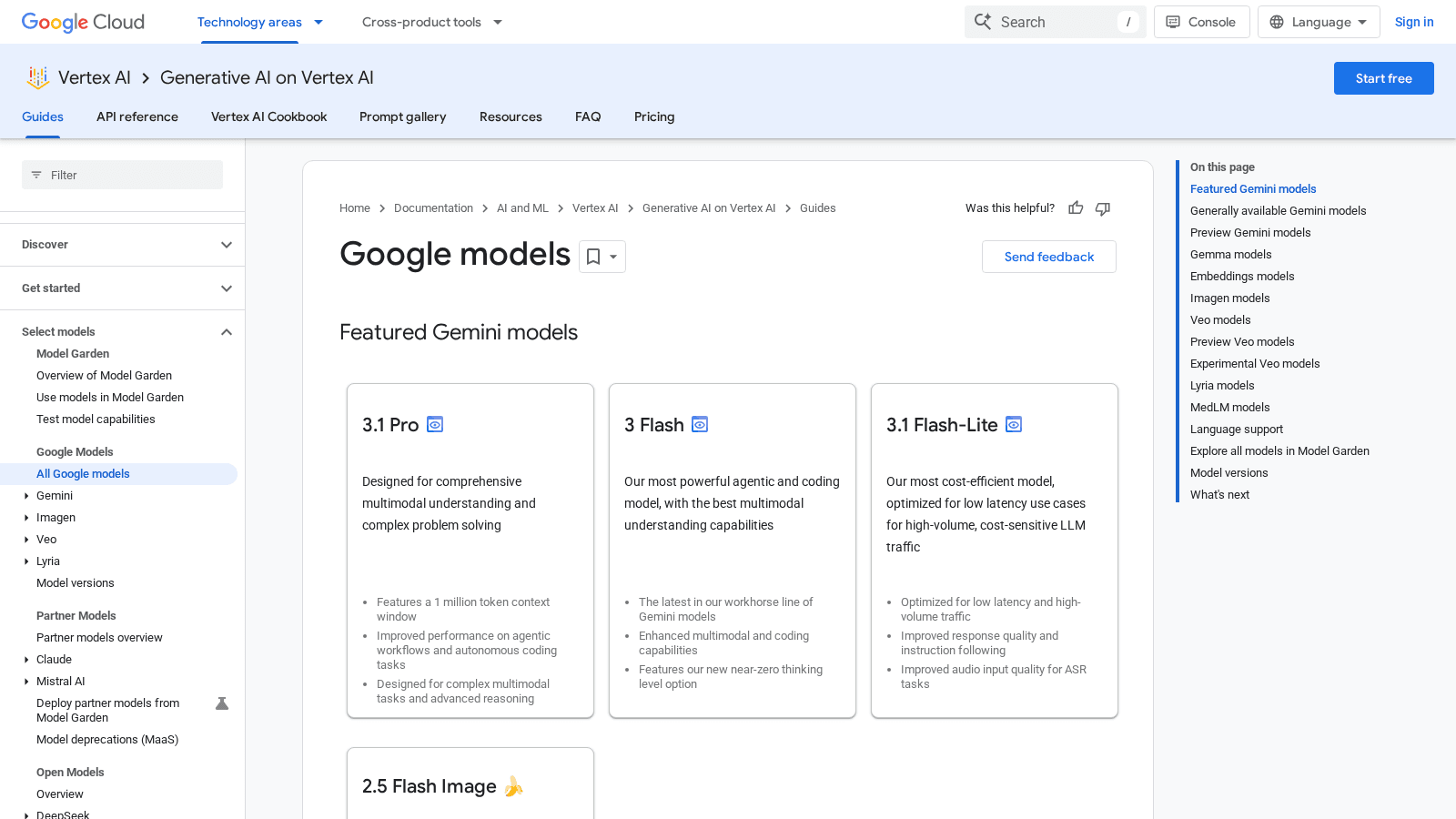
You were right to call this out. Google's current Vertex AI docs do explicitly list Gemini 3.1 Pro and Gemini 3.1 Flash-Lite, and the featured Gemini section currently highlights 3.1 Pro, 3 Flash, and 3.1 Flash-Lite. So any version of this article that frames Google's lineup as if it stopped at 2.5 is incomplete.
At the same time, Google's own documentation still makes the model story feel split across two layers. The All Google models page highlights the newer 3.x family, while the same page's Generally available Gemini models section still prominently lists Gemini 2.5 Pro and Gemini 2.5 Flash-Lite. The pricing page also shows both worlds at once: Gemini 3.1 Pro Preview and Gemini 3.1 Flash-Lite Preview appear there alongside the more established 2.5 pricing rows.
So what is actually current?
The careful answer is this: Gemini 3.x and 3.1 are current in the live Vertex AI documentation and model catalog. They are not imaginary, outdated, or hidden. But 2.5 is still part of the practical production conversation, because Google's generally available model section and pricing tables still give it a very visible role.
That means developers are dealing with a mixed reality:
- Newest featured path: Gemini 3.1 Pro, Gemini 3 Flash, Gemini 3.1 Flash-Lite
- Still-prominent GA path: Gemini 2.5 Pro, Gemini 2.5 Flash, Gemini 2.5 Flash-Lite
- Pricing and rollout nuance: 3.1 entries show up as preview SKUs on the pricing page, while 2.5 remains deeply embedded in the stable and grounded-prompt pricing guidance
What Google is doing well
Google clearly has a broad and ambitious model stack. The official docs now show a fast-moving Gemini family with distinct model roles for advanced multimodal reasoning, agentic coding, image generation, and lower-latency cost-sensitive work.
That is not the profile of a vendor standing still. If anything, the current docs show Google moving quickly enough that the public documentation, pricing language, and rollout states are overlapping in ways that are easy for outsiders to misread.
Where the frustration still comes from
The complaint I still stand by is not that Google lacks strong models. It is that the developer story is fragmented.
- The model catalog is current, but not simple: featured, generally available, and preview labels all matter.
- The pricing page is rich, but cognitively heavy: preview SKUs, flex or batch pricing, cached inputs, grounded prompt quotas, and separate rate-limit tiers all add overhead.
- The product surfaces still overlap: AI Studio, Gemini API, and Vertex AI each solve slightly different pieces of the same problem.
That is why developers end up feeling confused even when the docs are technically up to date.
The practical guidance now
If you want the newest Google path: look at the featured Gemini 3.x and 3.1 models in the current Vertex AI catalog.
If you want the most clearly production-shaped path: keep an eye on which models Google itself places in the generally available section and how they appear in the live pricing tables.
If you are comparing cost and rollout status: do not assume the newest named model and the most operationally settled model are the same thing.
The corrected bottom line
The real story is not "Google is on 2.5" and it is not "everything is fully 3.1 now." The truth in Google's own docs is more nuanced: Gemini 3.1 is current and featured, while Gemini 2.5 is still highly visible in generally available and pricing-oriented production guidance.
That is exactly why the Google ecosystem feels powerful and messy at the same time.
Cover image attribution: official screenshot captured from Google Cloud Vertex AI documentation on 2026-04-08: Google models | Generative AI on Vertex AI.
Sources used for this correction: