A Different Kind of Frontier Story
MiniMax M2.7 matters for two reasons. First, the model itself is genuinely competitive for coding, agent workflows, and office productivity. Second, MiniMax has wrapped that capability in a pricing model that is easier to understand than the usual per-model, per-modality sprawl.
That combination is what makes this article worth reading. Plenty of AI companies can tell a benchmark story. Fewer can pair a credible model with a pricing structure that feels designed for real usage instead of billing gymnastics.
What MiniMax M2.7 actually is
According to MiniMax's own release notes and model documentation, MiniMax-M2.7 launched on March 18, 2026. It is positioned as a text model for coding, tool use, search, office productivity, and complex agent scenarios, with a standard variant and a faster M2.7-highspeed variant.
The official API docs list a 204,800-token context window, around 60 tokens per second for the standard model, and around 100 tokens per second for the high-speed version. MiniMax also exposes the model through Anthropic-compatible and OpenAI-compatible API paths, which is useful for teams who do not want to rework their entire tooling stack just to test it.
Why developers are paying attention
MiniMax's own launch material puts M2.7 squarely in the conversation for real engineering work. The company reports 56.22% on SWE-Pro, 55.6% on VIBE-Pro, and 57.0% on Terminal Bench 2. Whether you treat those as marketing claims or early indicators, the pattern is clear: MiniMax wants M2.7 to be evaluated as an agentic coding model, not just another chatbot.
The more interesting framing is qualitative. MiniMax emphasizes interleaved thinking, tool use, native agent-team behavior, and office-document workflows across Word, Excel, and PowerPoint. That makes M2.7 feel less like a generic language model pitch and more like a bid to win developer and operator workflows directly.
The Token Plan is the sharper differentiator
The bigger commercial story is MiniMax's Token Plan. Instead of making users juggle separate pricing structures for each model family, MiniMax offers subscription tiers that bundle access across text and multimodal products.
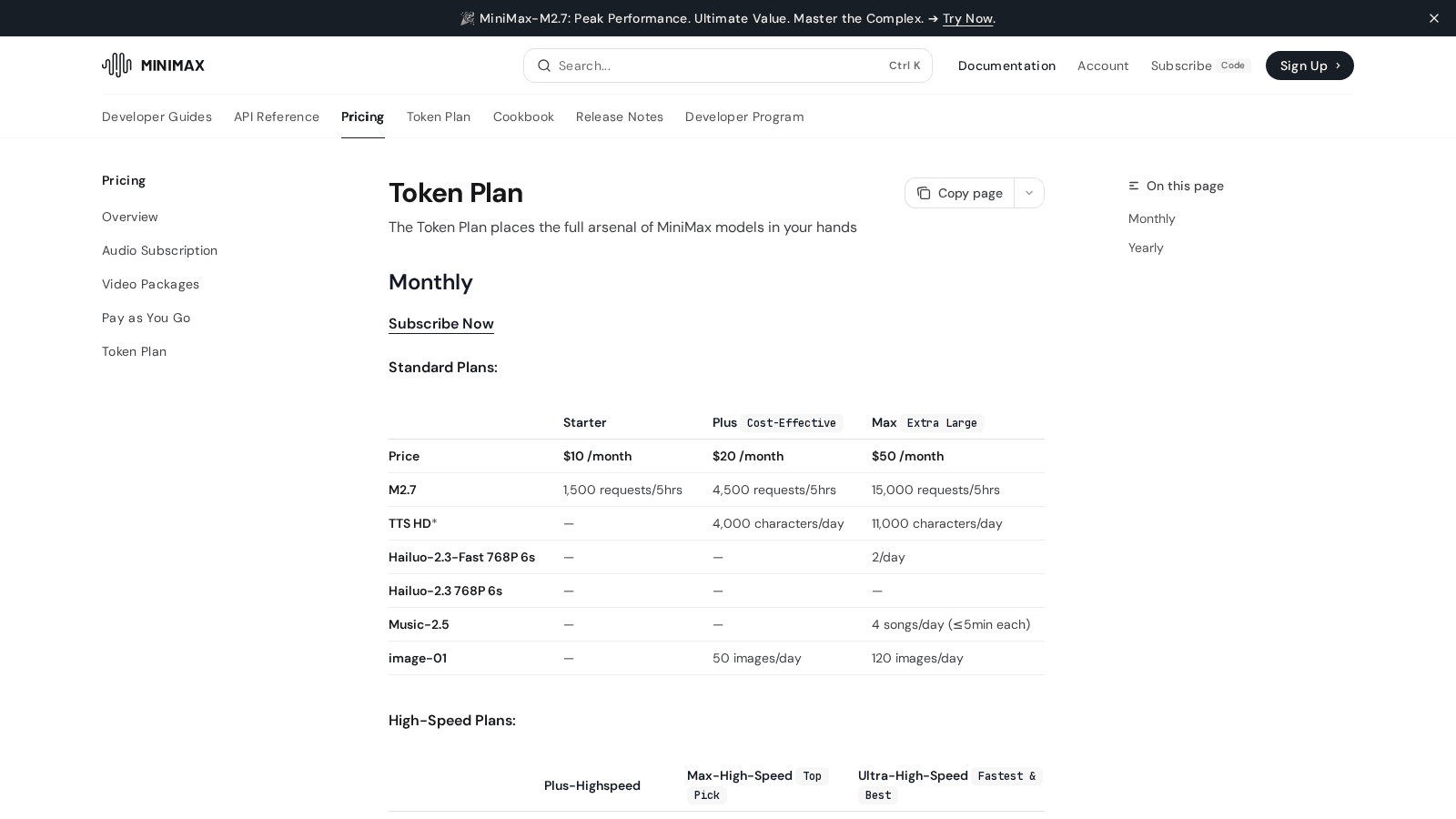
On the current official pricing page, the standard monthly plans are:
- Starter — $10/month: 1,500 M2.7 requests every 5 hours
- Plus — $20/month: 4,500 M2.7 requests every 5 hours, plus TTS HD and image generation allowances
- Max — $50/month: 15,000 M2.7 requests every 5 hours, plus larger speech quotas, image generation, music generation, and Hailuo video access
Cover image attribution: official screenshot captured from MiniMax Token Plan documentation on 2026-04-08: MiniMax API Docs: Token Plan.
MiniMax also offers high-speed plans at $40, $80, and $150 per month for the faster M2.7-highspeed path and broader multimodal quotas.
That structure is more topical than the generic "AI subscription" label suggests. This is not just one text model behind a paywall. It is a deliberate attempt to make one bill, multiple modalities, and predictable request bands the product.
What is bundled
MiniMax's API overview says the Token Plan supports MiniMax models across all modalities. In practice, that means the plan can cover:
- MiniMax M2.7 / M2.7-highspeed for text, coding, and tool use
- speech-2.8 and related TTS HD models for voice output
- image-01 for image generation
- MiniMax-Hailuo-2.3 and Hailuo-2.3-Fast for video generation
- Music 2.5 and newer variants for music generation
That bundled model lineup is the reason the plan is more interesting than a plain discounted text subscription. It is aimed at teams building products that cross text, voice, image, and video without wanting four separate vendors and four separate invoices.
Where the value proposition is strongest
For developers: M2.7 looks most attractive when you need agent workflows, coding help, or integration-friendly APIs without frontier-model pricing from the biggest US labs.
For startups: predictable subscription bands make budgeting easier than pure token-metering, especially if a product genuinely spans text plus one or two other modalities.
For teams experimenting with agents: MiniMax's Anthropic-compatible and OpenAI-compatible API paths reduce switching friction, and the company's own docs heavily emphasize tool use and long-horizon execution.
The honest trade-offs
The upside is clear: strong official positioning around coding and agent work, large context, fast variants, and a more coherent multimodal pricing story than many competitors offer.
The trade-offs are also real: the ecosystem is younger, the global tooling footprint is smaller, and many buyers will still want independent benchmarking and long-term reliability evidence before betting heavily on it.
So the sober conclusion is not that MiniMax has already won. It is that MiniMax has created one of the more credible alternatives to the usual frontier-AI pricing model, and that alone makes it worth serious attention.
Bottom line
MiniMax M2.7 is interesting because the model and the commercial packaging reinforce each other. The model is sold as an agentic, coding-capable system with long context and strong productivity performance. The Token Plan is sold as one subscription spanning text, speech, images, music, and video.
That is a more topical and more useful story than generic benchmark hype. If you care about multimodal products, predictable spend, or testing a younger but ambitious frontier stack, MiniMax is no longer something to ignore.
Sources: