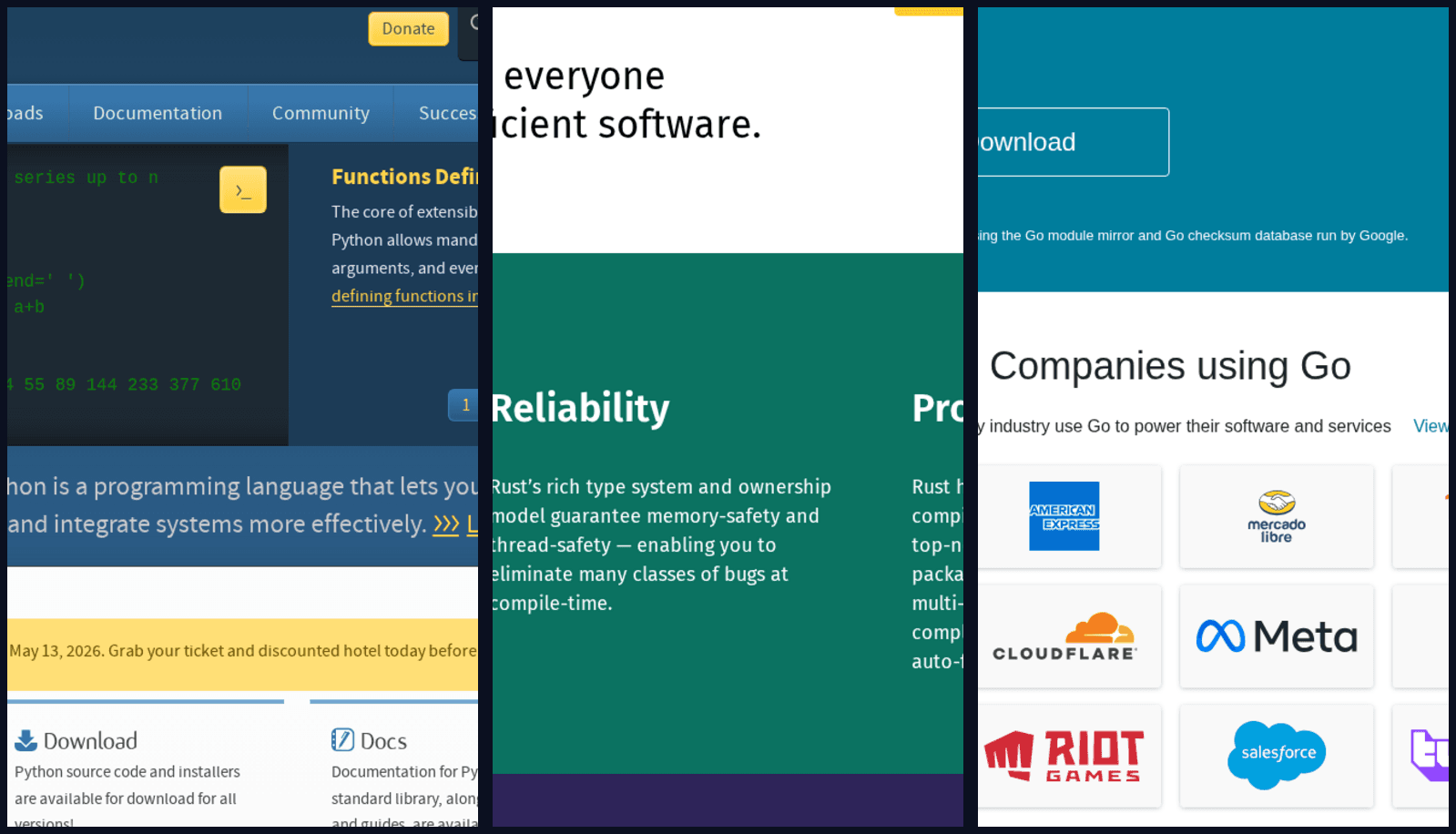
All Three Are Very Alive In 2026
If you are choosing between Python, Rust, and Go in 2026, the first useful fact is that none of them feels stale. Python.org is currently offering Python 3.14.4. The Rust project has published Rust 1.94.1 on its official blog. Go's downloads page lists Go 1.26.2 as the current stable line.
So this is not a choice between one modern language and two fading ones. It is a choice between three strong ecosystems with very different priorities.
Python: fastest path from idea to useful system
Python's own homepage still describes it well: it lets you work quickly and integrate systems more effectively. That is exactly why it keeps winning so many real-world decisions.
If you need to automate a workflow, build an internal tool, iterate on an API, glue systems together, or move quickly in AI and data work, Python is usually the least resistant path from idea to something useful.
Choose Python when
- speed of iteration matters more than absolute runtime efficiency
- you are working in AI, data, scripting, or automation
- you need the broadest ecosystem and the lowest friction for experiments
The trade-off is familiar: once raw concurrency, memory control, or high-throughput performance become the centre of the problem, Python often needs architectural help rather than solving it natively.
Rust: strongest guarantees, highest learning curve
Rust's official positioning is still one of the clearest in the industry: it is a language for building reliable and efficient software. The homepage leans hard into memory-safety, thread-safety, predictable performance, and a tiny resource footprint. That is not marketing fluff. It is the core bargain Rust offers.
If correctness, control, and performance are first-class requirements, Rust is incredibly compelling. It gives you low-level capability without accepting low-level sloppiness as the price.
Choose Rust when
- performance and correctness both matter a great deal
- you are building infrastructure, security-sensitive services, or systems code
- you are happy to spend more effort up front to reduce failure later
The cost is cognitive load. Rust can absolutely pay that back, but it asks more of the team than Python or Go on day one.
Go: operational calm without much ceremony
Go's current homepage tagline remains spot on: it is about building simple, secure, scalable systems. That is why it continues to feel so sensible for APIs, services, platform tools, and cloud infrastructure.
Go does not try to be the most expressive language in the room. It tries to be the language that lets a team ship, deploy, and maintain backend systems without too much drama. That is a very valuable thing.
Choose Go when
- you want backend performance with lower team friction than Rust
- you are building services, APIs, tooling, or cloud-native systems
- operational simplicity matters as much as language cleverness
The trade-off is that Go can feel deliberately blunt. If you want richer abstractions or tighter low-level guarantees, you may start to feel the edges of that pragmatism.
So Which One Should You Pick?
Pick Python when the question is, "How quickly can we get to something useful?"
Pick Rust when the question is, "How much correctness and performance can we guarantee?"
Pick Go when the question is, "How do we build something operationally calm, understandable, and scalable without too much ceremony?"
That is why these languages coexist so comfortably. They are not truly fighting for the same job.
Bottom Line
There is no universal winner here, and pretending otherwise usually leads to bad decisions. The smart choice is the one that reduces the real cost of delivery for the team and the system you actually have.
Python still wins on speed of iteration. Rust still wins on control and guarantees. Go still wins on straightforward service engineering. In 2026, that basic shape remains remarkably stable.
Cover image sources: Python.org, Rust-lang.org, and Go.dev, captured on April 8, 2026.